
I would never consider myself a serious comedian by any stretch of the imagination, but enough video exists to prove that I’ve dabbled in the form. A sense of humor can be a good tool to getting a point more clearly across. Hopefully, it makes the whole thing a bit more enjoyable to read. Let’s get into it.
If we look at how institutional media funds like analyze the media market, the smart money in media is moving directly into scalable, cross-media IP rights. In their framework for the New Content Economy, value creation migrates away from transient digital ad buying toward audience-driven IP ecosystems (i.e. communities) that yield low correlation to traditional asset classes and have accelerated capital cycles through structured co-financing. I’ve written about this as well, using Coca-Cola’s purchase of Columbia as an earlier example.
Last month, I wrote about how behavioral literature complements these insights. Rahmani et al. (Behavioural Public Policy, 2025): narrative solves advertising’s consent problem. Overt ads trigger immediate cognitive avoidance, while long-form narrative allows an audience to voluntarily sit and surrender their attention without a defensive reflex firing.
Logically, this implies that a smart media operator would overlay the capital framework onto these behavioral mechanics to close the structural flaw in modern marketing.
The decade-long strategy of treating UGC as the holy grail of brand building is coming to a close.
Marketers mistook a temporary distribution arbitrage for a permanent structural law. Ad agencies spent ten years flooding our social media feeds with low-fidelity microvideo under an assumption that ‘informal’ equaled effective. That channel is now being degraded by AI slop.
For the last decade, corporate America’s stab at authenticity took a weird cinéma vérité shape (but not the good kind): ‘If it looks like a professional shot it, the consumer will know you’re trying to sell them something. They’ll think this is an ad!’ (At this point, you hear Anton Chigurh’s voice remind you, “Which it is.”) ‘What you want is a guy holding a phone at a weird 45-degree angle in a poorly lit kitchen, whispering into a lapel mic like he’s trying not to wake his roommates.’
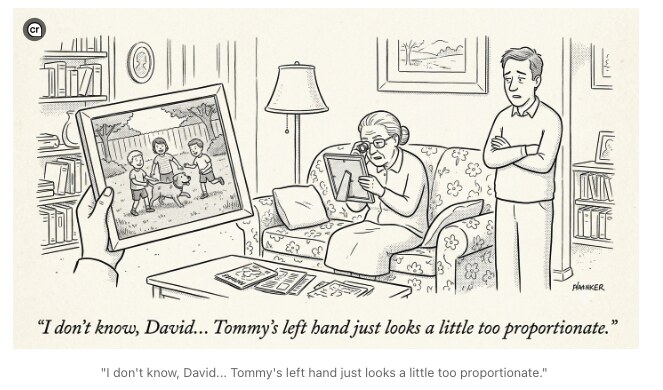
Now, ten years later, the kitchen isn’t real. And that guy has a computer-generated face, and six fingers on his left hand. (And not in a cool way either. There are no 12-fingered pianists gifting us beautiful arpeggios.)
The Immunity Curve
My first point. “The immunity curve.” It sounds like the sequel to The Andromeda Strain. But here, when it comes to how audiences are responding to A.I. images, let’s resist the softest form of the argument, which is that consumers will get tired of AI images. That is a taste claim, and taste claims are worthless in a capital-allocation memo, because taste can reverse. Signaling claims do not reverse. So let’s make a habituation argument.
outlined modern advertising theory in 1974. For experience goods, the content of the ad is largely noise. The real information transmitted is the expenditure itself. The consumer cannot evaluate the product from the commercial, so the consumer unconsciously evaluates the commercial as a proxy for the business itself. Somebody spent real money here. Somebody who spent that much intends to still be in business next year, because otherwise they could never recoup it. Production value is not just a decoration; it functions as a , posted in public, at cost. Generative AI does not reduce the cost of the ad. In effect, it psychologically voids the bond. It’s like gifting artificial flowers to your valentine. (And not in a charming way, either.)
Put another way, for seventy years, if we saw a commercial with a helicopter shot over a mountain range and an orchestra and a guy in a beautiful coat, some part of our lizard brain went, ‘These people are serious. Nobody rents a helicopter to defraud me!’ The mountain was irrelevant. The coat was irrelevant. But now the helicopter is free. A guy in a basement in Ohio generated forty helicopters this morning while waiting for a burrito and pondering why Bumble can’t help him get any attention from the women in his area. We would be deluded to think, ‘Look how cinematic our brand feels now!’
Now run the depreciation schedule on novelty, because the historical curve is consistent and accelerating.
Jurassic Park bought roughly a decade of awe for photoreal CGI. Auto-Tune bought about four years before it flipped from technology to Jay-Z’s punchline. Instagram filters bought maybe three. The first wave of AR lenses bought eighteen months. Each successive visual novelty holds its premium for a shorter interval than the one before it, because the population’s pattern-recognition apparatus trains on a larger corpus and updates faster every cycle.
The relevant unit for synthetic video is not years. “Ad wear-out” research has consistently found that recall and persuasion for a given execution decay measurably after a handful of exposures at normal frequency. Consumers are currently absorbing synthetic imagery in the hundreds per week. The “immunity window” is not a generational shift.
People act like this is going to be a slow cultural adjustment. But… week one, your mother sends you a photo of a cat riding a manatee and she writes ‘WOW.’
Week three, she sends another one and writes ‘is this real?’
Week six she sends one and writes nothing.
Week nine she stops opening them.
Week twelve she looks at an ACTUAL PHOTOGRAPH of her ACTUAL CHILDREN and says, ‘Did you make this with the computer?’
But I don’t think the damage stops at synthetic content.
Once the base rate of fabrication crosses a threshold, consumers stop evaluating individual images and start applying a blanket prior of falsity to the entire category of captured imagery. Real footage, of a real product, on a real body, in a real location, draws the same skeptical flinch, because the viewer has no cheap method of distinguishing the two and has learned that the expected cost of being fooled exceeds the expected benefit of believing.
This is the running in reverse, against the advertiser. It vaguely feels familiar to the parable of the boy who cried wolf, but dissecting myths is another man’s specialty. Brands flooding feeds with synthetic assets are salting the ground under every photograph anyone will ever take of their products again.
(For folks needing help with that last metaphor: in the past, armies would literally spread salt on conquered fields to poison the soil and ruin a rival city’s ability to farm.)
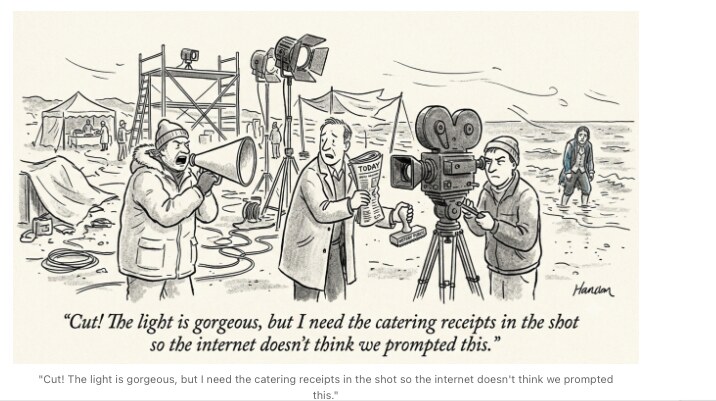
One day, some poor brand is going to do everything right. They’re going to fly a real crew to a real coastline, hire a real photographer, shoot a real model in a real dress in real wind, and it is going to be gorgeous. And they’ll post it. And the top comment, with eleven thousand likes, will be ‘ai slop.’ And the marketing director will get on a call and say, ‘No, no, you don’t understand, we HAVE the call sheets, we have the location permits, we have the CATERING RECEIPTS,’ and nobody is going to care, because we cannot litigate a vibe.
When short-form becomes infinitely cheap and frictionless, it stops being a high-converting asset and starts looking like digital litter. Goldman’s work on pricing power in media points at the same structural truth from a different angle: scarcity is the only durable input to margin. When supply of a good approaches infinity, price approaches zero, and the entire category converts into a commodity nobody bothers to defend.
Production value is not just a decoration. It functions as a solvency bond, posted in public, at cost.
Vaccarello
In 2023, while most legacy brands were dumping millions into programmatic networks and influencer rosters, Anthony Vaccarello launched and stepped directly into the capital stack as a full-fledged co-financier of auteur cinema, backing features from Almodóvar, Audiard, Cronenberg, and Sorrentino.
Someone at Saint Laurent likely looked at their media plan one morning, looked at the Silicon Valley platforms, and said, ‘We are handing fifty million dollars a year to a tech company so people can flick their thumb past our silk dress in 0.08 seconds? Why are we doing this?’
Vaccarello understood the decay curve. A seasonal social campaign has a half-life measured in hours, but a feature backed as equity in a slate retains cultural authority and financial residual value for decades. The accounting treatment inverts along with the asset. Deploying marketing capital into long-form media under a capitalized framework moves the spend off the operating-expense line; rather than expensing capital to zero, slate participation sits on the balance sheet as an asset, amortizing across a multi-window revenue lifecycle while it compounds brand equity.
So, at the end of the fiscal year, the CFO sits down with the brand team. ‘Okay, under Operating Expenses I see twenty-five million dollars for Digital Impression Yield. What do we own at the end of this transaction?’ And the answer will be, ‘Well, we don’t own anything in the traditional sense, but we generated tremendous brand momentum.’ ‘Great. Can I take that momentum to the bank and pledge it against a credit facility?’ And the only answer would be ‘…Not really.’ ‘So we spent twenty-five million dollars to rent air.’ ‘Yes, but it was very prettily rented air.’
Can everyone move like Vaccarello? I would argue, with some help, yes.
Marketing departments are not equipped to underwrite film risk. But that’s irrelevant, because nobody is asking a CMO to become a completion guarantor. Since the of the 1990s, brands have entered media partnerships as a limited partner in a co-financing vehicle, and if their equity stake takes the shape of a defined equity strip across five to eight pictures, then the sales agent, the bond company, and the distributor absorb the operational risk. What the brand buys is a position in the waterfall and a set of ancillary rights negotiated at the term sheet: costume and archive integration, premiere as owned media, campaign asset rights in perpetuity, and the right to be the reason the film exists. The right to be the reason a film exists is a form of authorship no amount of programmatic spend can ever purchase.
Of all of GEICO’s brilliant campaigns, its cavemen will endure even though its content never rose to the level of Shakespeare and Bacon’s earlier work. Actually, at the time, GEICO’s show about its cavemen was cited as being the worst show of all time. Nevertheless.
When we explain the to a brand executive for the first time, we can watch the color drain out of the room. ‘Okay, so first the distributor takes their fee off the top. Then P&A recoups. Then the senior lender. Then the gap financier. Then the mezzanine. Then deferred fees. Then negative cost. Then, and only then, we see profit participation.’ And he’s nodding slowly, and he says, ‘So we’re at the back of the line.’ And I say, ‘Yes.’ And he says, ‘That seems bad.’ And I say, ‘Where were you in line on the ad buy?’ And he goes, ‘What line?’
Now, this is where we go, ‘Charlie, there was no line. Last year, we spent forty million dollars and didn’t qualify for any position in any waterfalls. We didn’t have any TLC on the playlist.’
To which Charlie says, ‘What does TLC have to do with waterfalls, Daniel?’
As a matter of operating practically, in entertainment, the negative cost is not what the brand pays. A €30 million European art-house feature is not a €30 million exposure. Ireland’s returns up to 32 percent. The UK’s AVEC regime delivers roughly 25.5 percent net on qualifying spend. Hungary sits around 30. Georgia’s credit is transferable, which means it converts to cash at eighty-some cents on the dollar before principal photography wraps.
After one stacks the soft money against presales in the majors, layer a gap facility against unsold territories at a conservative 15 to 20 percent of the sales estimate, and the actual at-risk equity in a properly structured picture is frequently a third of the headline budget. So brands never have to fully finance a film. The brand should only be encouraged to finance the last, thinnest slice of a film that four other parties have already de-risked.
Quick aside: there is a guy whose entire job is soft money, and he walks in like he’s about to perform a magic trick. ‘Alright. Budget’s thirty million. Now watch this.’ And he starts pulling countries out of a hat. ‘Ireland gives us back nine. Interiors in Budapest, that’s four. The Belgian shelter takes a bite. Now presell Germany, France, Benelux, that’s another eight against delivery.’ Someone raises a hand and asks, very quietly, ‘Is this legal?’ The Soft Money Man turns crestfallen. Slides his nose under his finger. ‘IS IT LEGAL? THESE ARE SOVEREIGN INDUSTRIAL POLICIES. GOVERNMENTS WANT US TO DO THIS.’ Then he stomps out.
Okay, this guy doesn’t exist, and if he does, he’s only slightly less unhinged on average. But jokes aside, it does work this way. In a way. Look, we made it this far; I’m trying to keep the read entertaining, but you get what I’m driving at. Independent film, smartly engineered, is already heavily subsidized, so you’re shouldering the risk to create a cultural product alongside other institutions. We can’t do this in the digital space in the same way.
The second objection is more serious: film returns are non-normal. The distribution is fat-tailed, the median picture underperforms, and a slate needs one outlier to carry the book.
But run that same variance analysis against the asset class the money is currently leaving, and the comparison stops being close. A digital ad buy has a of one hundred percent. Definitionally. There is no recovery, no salvage, no residual, no library value, no secondary market, no asset on the balance sheet at the end of the impression. The entire category is a zero-recovery instrument the industry has simply agreed to stop describing that way. Against that benchmark, a slate position returning forty cents on the dollar in hard recoupment, plus a library interest that licenses across windows for three decades, is not a risky substitute. It boasts better tax treatment and an amortization schedule a CFO can defend to an audit committee.
The CMO can stand up in the annual review and say, ‘This year we financed six features. Two lost money. One broke even. Three are in profit. Aggregate recovery on deployed capital was 61 percent, and we hold a permanent library interest.’ Maybe half the board is horrified. ‘YOU LOST MONEY ON TWO FILMS?’ But she stiffens her posture and says, ‘Last year we put the same capital into digital and recovered zero percent.’
In a market where nothing can be authenticated, the only surviving signal is a production apparatus too heavy and too regulated to counterfeit.
The Friction Is the Product
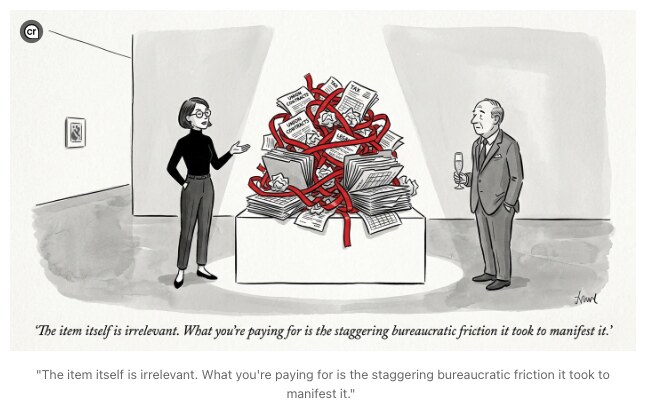
Friction used to be the product. The barrier to making an image produced actual scarcity, and since we no longer have a scarcity of images, it’s tempting to think of images as finished, categorically.
But… a true feature film cannot be faked into existence, and this is a structural property rather than an aesthetic one. Since film carries a shooting schedule, a completion bond, an insurance policy, guild agreements, a distributor, a chain of title, an audit trail on every dollar of qualifying spend claimed against a jurisdiction’s credit, and a thousand people who were physically present, cinema’s provenance is not a marketing claim. In a market where nothing can be authenticated, the only surviving signal is a production apparatus too heavy and too regulated to counterfeit.
The reason the film is valuable is that it was annoying to make.
The flight away from UGC to narrative IP won’t be a result of a preference for prestige; cinema retains an authenticity enforced by capital structure rather than by consumer goodwill. The brands that keep renting attention will be renting it in a market where attention itself has gone worthless, bidding for placement against an infinite machine that produces the identical product for free.
The brands that capitalize into narrative will own the small number of cultural objects people still voluntarily pay to sit in front of. One group is buying a fixed asset in a market with permanently constrained supply. The other is buying sawdust, at scale, with a very impressive dashboard.
Saint Laurent did not co-finance Almodóvar because auteur cinema is beautiful.
They co-financed it because in ten years, it will be one of the remaining things anyone can verify actually happened.